In a rare interview, global chief executive John Flecker outlines his growth plans and virtual approach to running the construction giant.
John Flecker has spent his entire working life with one company, yet he has seen more change than many others experience during their careers.
He joined Multiplex in 1987 when the construction company was led by its entrepreneurial founder John Roberts.
His job interview was on a Saturday morning at Mr Roberts’ Mosman Park home, and he recalls being greeted at the door by his prospective boss in a dressing gown.
As global chief executive, Mr Flecker now reports to the board of Toronto-based investment giant Brookfield, where the dress code would be conservative dark suits.
In between, there was a period when Multiplex was listed on the Australian Securities Exchange and had to grapple with a disastrous project at London’s Wembley Stadium.
Through these major changes, Mr Flecker said there had been a lot of consistency in how Multiplex operated.
“One thing that has been absolutely consistent through the journey is the mantra that our capital is our people,” he said.
“We own a few cranes and a few hoists and site sheds but basically our equity is our people, our [2,600] staff.
“And they help our sub-contractors be productive and happy and make a quid.
“If our subbies are happy and make a quid, they come back and do the next job.
“If they are successful, we are successful.”
It’s a formula that clearly works, judging by the number and prominence of the company’s projects.
Multiplex is a clear market leader in Western Australia, having completed more than 300 projects across its 60-year history, including many of Perth’s largest buildings.
Globally, it has delivered about 1,100 projects, collectively worth $US100 billion and shaped the skylines of Sydney, Melbourne, Brisbane and other cities around the world.
The company’s growth is continuing apace. It has recorded average annual revenue of $US4.3 billion over the past five years and secured $US15 billion of future work.
As the Perth-based chief executive of a major global business, Mr Flecker is a rarity in the WA business community.
He joined Multiplex 35 years ago as one of its first cadet site engineers and proceeded to rise steadily through the ranks.
In 2011, he was promoted to chief executive Australasia, when management responsibility was divided between the Northern Hemisphere and Southern Hemisphere operations.
In 2019, the two roles were united, and he was promoted to his current position.
His seniority contrasts with his low public profile and easygoing demeanour.
In fact, Mr Flecker admits to mingling incognito with new graduate recruits, most of whom don’t realise who they are talking to.
He characterises the company’s business model as global plus local.
Each region has its own leadership with a high degree of autonomy.
Regional managing director Chris Palandri fills that role for WA, which accounts for about 20 per cent of the group’s operations.
“We need local leadership because most of our clients are local and the workforce and subbies and unions are local,” Mr Flecker told Business News.
Sitting over that is a global executive group comprising just eight people, leading areas including legal, finance, systems and HR.
“That group is the glue that makes sure we share knowledge and best practice,” Mr Flecker said.
“It gives strategic consistency to what we are doing”.
Mr Flecker emphasises Multiplex maintains a very lean and flat structure, with the regional heads meeting with the leadership group.
“We all sit in the room together; there isn’t a big head office that sits above the operations,” he said.
Mr Flecker operates with what he calls a virtual head office, leading the company’s operations in multiple states and multiple countries.
“Wherever you sit is a little bit irrelevant,” he said.
While he is based in Perth, his chief financial officer is based in Toronto, his chief information officer is in London and other executives, such as head of legal and head of people, are in Sydney.
“I don’t think of a head office, it’s a virtual thing,” Mr Flecker said.
“I don’t know what other companies do but that’s how we do it.”
He believes the dispersed geographic spread can be a positive.
“It forces us to collaborate and talk across regions because we have executives spread across the world,” Mr Flecker said.
That interaction comes through a mix of virtual and face-to-face meetings.
“We have tried to become very much a global business and getting the best out of all the parts, it’s as connected as it has ever been,” he said.
Asked about his own role, Mr Flecker is short of words.
He offers briefly that he is proud to have risen to his current role, while also feeling like he is the custodian of a precious thing.
While he agreed to this interview to mark the company’s 60th anniversary, Mr Flecker has no urge to build his own profile, preferring to work behind the scenes.
“I prefer to let our staff and our buildings do the talking,” he said.
“Our advertising is our building sites and our cranes.”
Reflecting on the company’s history, Mr Flecker is clearly a fan of the late Mr Roberts, who founded the company in 1962 while aged in his early 30s.
“A larger-than-life character, terrific individual, very entrepreneurial, and there weren’t a huge amount of rules,” Mr Flecker said, adding that Mr Roberts set a high standard for hands-on, empathetic leadership.
“He was a terrific motivator of people.
“He was very much at ease talking to people on the site and just as happy dealing with the entrepreneurs and even hosting the Queen at his horse stud.”
Geoff Allen, who spent 40 years running Multiplex alongside Mr Roberts, reflects on the different style of business in the early days.
“Our word was our bond,” Mr Allen told Business News.
“We went for years without having a signed contract.”
Multiplex expanded overseas during the 1990s, to Dubai and London, and one company that expanded with it was engineering consultancy BG&E.
Former chairman Rob Johnson says the two companies worked together on some highly innovative projects. He attributes a lot of Multiplex’s success to loyalty.
“They are loyal to the people who do a good job for them,” Mr Johnson said.
Multiplex listed on the ASX in 2003 after raising $1.2 billion through a public share offer; a figure that still stands as a record for WA’s largest IPO.
By this time the Roberts family’s next generation was leading the company, with chief executive Andrew Roberts based on Sydney.
Mr Flecker said the four years as a listed company brought with it a lot more rules but less focus on long-term development of the business.
“You had this never-ending quarterly cycle of dealing with the analysts and their expectations of the stock,” he said.
The ASX listing came to an end when Brookfield bought the business for $7.3 billion.
After 15 years of Brookfield ownership, Mr Flecker said Multiplex had found a happy medium.
“We are owned 100 per cent by a listed entity but we’re not listed ourselves,” he said.
“Because we are reporting direct to a listed entity, we need to have that financial discipline.
“But because we are part of a much larger business, we have the luxury of not having to worry about the quarterly cycle of analysts and reporting, and that gives us the ability to have a much longer-term view.”
Mr Flecker said this long-term view meant there was no pressure to achieve growth for growth’s sake. Nonetheless, Multiplex was aiming to grow into new sectors and new geographies.
“We have our own aspirations, we want to grow, but our aspirations are very sustainable,” he said.
Mr Flecker noted that Multiplex already had a large share in its core market: major buildings in central city locations.
That meant it was not easy to grow in that space, he said.
In Perth, for instance, its projects have included many of the city’s major office towers, such as Central Park, 108 St Georges Terrace and Brookfield Place.
It has also built Fiona Stanley Hospital, Crown Towers and Optus Stadium, and is currently building some of Perth’s largest apartment developments.
Mr Flecker said the company was seeking to grow by diversifying into new sectors; for instance, it has been doing a lot of health work in regional areas, including Karratha Hospital.
It is also contracted to build Edith Cowan University’s $853 million campus in central Perth.
The big new opportunity he sees is defence.
“In Australia, the one thing we are really interested in is to get a slice of the federal government’s defence portfolio,” Mr Flecker said.
“It would still be building works but for a different sector.
“That’s something we have not done before but we are pursuing that.”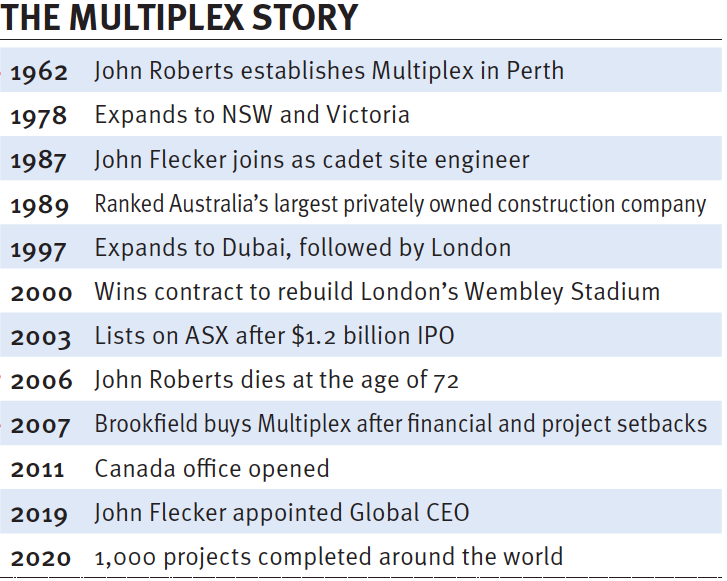
Multiplex’s geographic diversification means expanding beyond Australia, which accounts for up to three quarters of the group’s operations.
Its international operations are in the UK, mostly in London, and in Canada, mostly in Toronto.
As it moves into new markets, the group will no doubt draw on its experience from one of its most difficult projects.
In September 2000, Multiplex signed a contract with England’s Football Association to demolish and rebuild London’s iconic Wembley Stadium.
This was just a short while after the company had entered the UK market and it regarded Wembley as an opportunity to stamp its mark.
However, the large and complex project took much longer than anticipated and suffered a huge cost blowout, from an original estimate of £326 million to a final figure close to £900 million.
Mr Flecker refers to two legacies from Wembley.
“We hung in there and we are still there [in London],” he said.
“It was obviously a very challenging project, but we got it finished.
“One of our stated values is that we have grit, and there was a good example.
“The other lesson is that if you enter a new market, you might start with smaller projects and with building types where you have experience, not with a complex, bespoke project.”
Mr Flecker said companies entering a new market needed to be patient.
“It takes a long time to get your roots into a region,” he said.
“In Toronto, we are the new kid on the block and there are some established players.
“You need at least a decade to establish yourself in a new region.”
Mr Palandri, who has also been with Multiplex more than 30 years, said the group drew on its extensive experience when it tackled projects.
“There is a hard-nosed element to delivering construction projects on time and on budget, there is no question about that,” Mr Palandri told Business News.
“The beauty we have through 60 years is a very good, well-run system, or process, for delivering our buildings that our staff know and our sub-contractors know.
“That process isn’t written down [but] it’s known in the organisation and among the sub-contractors.
“It’s certainly not formulaic, every project is bespoke, but there is generally a rhythm to the way we build, the sequence we follow and how we tackle things.
“And we are very collaborative.
“Because we rely so heavily on the sub-contractors, we involve them heavily in the decision making.”
Mr Palandri emphasised the important role played by long-term staffers, who nurtured and mentored new people to achieve consistency.
He said people in the organisation had a lot of pride in the brand, which was something that became apparent when the company reverted to its original branding and tag line: Multiplex – Built to outperform.
That was after a period of several years when it was known as Brookfield Multiplex.
Mr Palandri recalls being surprised at how much impact the shift back to the original branding had.
“The lift in the mood across the organisation was enormous,” he said.
Mr Flecker highlighted the important role played by both long-term staffers and long-term relationships with sub-contractors.
“Our clients get the benefit of that experience and history,” he said.
Highlighting the importance of subbies, he said building projects typically had a ratio of about 10 contractors to every one employee.
Mr Flecker said one of the key measures of success was the number of repeat clients.
“There is no better test than if clients come back to us and ask us to build the next building,” he said.
Hassell principal Peter Dean worked with Multiplex for more than 30 years, including on some of the biggest and most complex projects in the country.
“It is evident their success can be linked to doing many things very well, not the least being a simple and clear belief in the value of real teamwork in getting things done well and ahead of time,” Mr Dean said.
He added Multiplex’s success at “getting things done” often occurred following early involvement in projects.
“This enables a partnering mindset and approach to evolve, not only with their clients but with other key stakeholders and contributors in the supply chain where value and often innovation can be derived: architects, engineers, suppliers and subcontractors,” Mr Dean said.
“This approach generates not only great project outcomes, but also trusted relationships, the foundation for future success.”
One notable feature of Multiplex’s track record is its history of avoiding, or at least minimising, industrial disputes on its projects.
That was often attributed to the relationship between John Roberts and construction union boss Kevin Reynolds: two tough men who found a way to work together.
Michael McLean, who had dealings with Multiplex over 35 years while he ran the Master Builders Association of WA, says the company was very innovative in dealing with challenges, including in workplace relations, and its approach was not always popular with competitors.
“They were a front-runner in doing deals with the unions to mitigate liquidated damages claims,” Mr McLean recalls.
“That may have increased the price of their projects, but they were able to deliver on time and on budget, and their clients loved that.
“That created a lot of disharmony because other builders were trying to resist what they saw as exorbitant costs.” Mr Flecker said Multiplex was just being pragmatic.
“Without doubt we had a relationship with the union, but it wasn’t always fun and games,” he said.
“I started in the 1980s and it was tumultuous.
“We were one of the first companies back in those days that did embrace the unions and signed up agreements.
“That probably lives through our culture today.
“We are engaged with the unions; you can’t not be, they have rights to be there.
“We are more often friends than not. “They are as much a stakeholder in our projects as the clients and the sub-contractors and even our staff.”
Mr Palandri summed up the difference between Multiplex and other builders this way.
“You might find that some of our competitors have more adversarial relationships with every part of the construction chain,” he said.
“While it can be robust, we are trying to have a much more collaborative outcome with all stakeholders.”
Mr Flecker said a recent in-house study provided some perspective on this issue.
Multiplex looked at the cost of building the same high-rise office building in each of Australia’s four major cities.
Surprisingly, Melbourne was found to be the lowest-cost city despite the construction union in Victoria having a reputation for being the most militant in the country.
“How could it possibly be in Melbourne, it’s such a union stronghold,” Mr Flecker asked rhetorically.
“We have a healthy relationship with that union and we’ve been productive. I can’t remember the last time we had a strike in Melbourne, we don’t even talk about that word any more.
“A strong union does not necessarily mean not productive.”
Reflecting his pragmatic approach, Mr Flecker declined to comment on the federal government’s abolition of the Australian Building and Construction Commission: a body specially established to crack down on militant unions.
He said he was focused on working with the prevailing laws, whatever they were.
“I remember when the law in WA was ‘no ticket, no start’,” he said.
“You could not work on a building site without a union ticket. “Today the law is freedom of association, it’s completely the opposite.
“I can be philosophical about what’s right and what’s wrong, but you have to work within the law of the land.
“You have to be a little bit pragmatic.”

Recent Comments